

Tag: cheap Diablo 4 materials

Diablo 4 March of the Stalwart Soul Guide: How to Get and Best Paladin Builds

March of the Stalwart Soul is one of the most impactful Unique boots available to the Paladin class in Diablo 4, especially for players who favor speed, aggressive positioning, and constant pressure. Designed specifically to enhance the advanced basic skill, these boots turn mobility into a lethal offensive tool, allowing Paladins to dash through enemies while dealing devastating damage.

For builds that rely on fast clears, hit-and-run tactics, or fluid movement between packs, March of the Stalwart Soul is a defining piece of gear. In this guide, we’ll break down what these Unique boots do, their stats and effects, and the most reliable ways to farm them efficiently in Diablo 4.

What Is March of the Stalwart Soul in Diablo 4?

March of the Stalwart Soul is an Ancestral Unique boot exclusive to the Paladin class. Unlike standard movement-focused boots, this item is entirely built around empowering Advance, transforming it from a simple mobility skill into one of the strongest basic-skill damage tools in the Paladin kit.

Advance already offers repositioning and minor damage, but with March of the Stalwart Soul equipped, it becomes a long-range, high-impact attack that excels in both single-target engagements and high-density content. This makes the boots especially valuable for speed-farming, Nightmare Dungeons, and boss rotations.

Stats of March of the Stalwart Soul

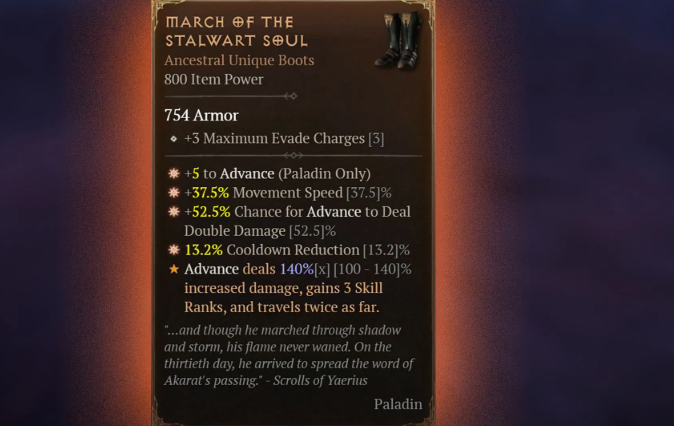
March of the Stalwart Soul rolls with a powerful mix of mobility, cooldown reduction, and skill scaling, making it one of the most efficient boots for aggressive Paladin builds.

Base affixes include:

·+3 Maximum Evade Charges

·+(2-3) Ranks to Advance (up to +5 with Masterworking)

·+(16.0-25.0)% Movement Speed (up to 37.5% with Masterworking)

·+(26.0-35.0)% Chance for Advance to Deal Double Damage (up to 52.5% with Masterworking)

·(8.1-8.8)% Cooldown Reduction (up to 13.2% with Masterworking)

These stats significantly reduce downtime between movement and damage windows. Extra Evade charges improve survivability, while movement speed and cooldown reduction ensure near-constant mobility. When combined with other optimized Diablo 4 Items, these boots allow Paladins to maintain pressure without sacrificing safety.

Unique Effect of March of the Stalwart Soul

The defining power of these boots lies in their Unique effect:

“Advance deals 100-140% increased damage, gains 3 Skill Ranks, and travels twice as far.”

This effect completely redefines Advance. The increased travel distance allows Paladins to cut through enemy packs or disengage instantly, while the massive damage multiplier and bonus skill ranks make it a legitimate primary damage source.

When paired with the chance for Advance to deal double damage, Paladins can rapidly clear dense packs while staying highly mobile-an ideal setup for endgame farming and speed-focused builds.

How to Get March of the Stalwart Soul in Diablo 4

March of the Stalwart Soul can drop from multiple sources, but targeted boss farming is by far the most efficient method. Below are the best ways to farm this Unique reliably.

Boss Farming (Best Method)

1) Varshan

·Location: Malignant Burrow Dungeon, eastern Hawezar

·Difficulty: Torment

·Boss Hoard Key: 12× Malignant Hearts

How to Get Malignant Hearts:

·Whisper Caches from Tree of Whispers rewar.ds

·Tortured Gift of Mysteries in Helltides (250 Aberrant Cinders)

·Kurast Undercity using Tribute of Titans

Varshan is one of the most efficient bosses to farm for Paladin Uniques thanks to relatively accessible materials and fast repeat runs.

2) Grigoire

·Location: Hall of the Penitent Dungeon, Dry Steppes

·Difficulty: Torment

·Boss Hoard Key: 12× Living Steel

How to Get Living Steel:

·Tortured Gift of Mysteries in Helltides

·Kurast Undercity using Tribute of Titans

·Asteroth during Escalating Nightmares

Both Varshan and Grigoire are excellent targets for farming March of the Stalwart Soul and other high-value Diablo 4 Items that synergize with mobility-based Paladin builds. Players looking to speed up the process can also buy Diablo 4 materials, such as Malignant Hearts or Living Steel,l to reduce preparation time.

Nightmare Dungeons (Secondary Method)

March of the Stalwart Soul can also drop from:

·Random enemies

·Elite packs

·End-of-dungeon reward chests

Nightmare Dungeons with high monster density are the best option if you want to farm experience, Glyph upgrades, and crafting materials simultaneously. While drop rates are lower than targeted boss farming, this method offers strong overall progression value.

Best Builds for March of the Stalwart Soul

These Unique boots excel in:

·Advance-focused Paladin builds

·Mobility-based melee setups

·Speed-farming and high-density content builds

They pair exceptionally well with cooldown reduction, movement speed stacking, and effects that reward frequent repositioning. When fully optimized, Advance becomes both a primary damage dealer and a near-constant movement tool.

Final Thoughts

March of the Stalwart Soul stands out as one of the most impactful Unique boots for Paladins in Diablo 4. Its powerful stat package, massive Advance damage multiplier, and enhanced mobility make it a top-tier choice for players who value speed, aggression, and fluid combat.


Diablo 4 Season 10 Unique Items: Maximizing Chaos Armor Potential

A new Diablo 4 season always brings excitement, and Season 10 is no exception. With the arrival of Chaos Perks and the innovative Chaos Armor mechanic, Blizzard has introduced a fresh set of Unique Diablo 4 Items for each class. These powerful gear pieces are designed to reshape buildcrafting, offering new synergies and strategies that reward experimentation and skill.

While not every Unique in Season 10 will redefine the meta, several show immense potential for endgame viability. This guide will break down the new Uniques by class, explore their affixes, and explain how Chaos Armor enhances their utility. Additionally, we’ll highlight ways to efficiently obtain the necessary Diablo 4 Items.

Chaos Armor and Its Impact on Unique Items

Season 10’s Chaos Armor system is more than a cosmetic or marginal feature; it fundamentally changes how players approach gear slots. Traditionally, certain Uniques were locked to specific equipment slots, meaning their synergies with other high-value items were limited. With Chaos Armor:

·A Unique item can now appear in alternate slots, enabling combinations that were previously impossible.

·Builds that relied on one or two high-tier items now have the flexibility to include multiple powerful Uniques.

·Items previously considered underwhelming gain relevance because they can now coexist with other key pieces.

For players aiming to dominate endgame content, this opens vast new opportunities. By combining Chaos Armor with the right Diablo 4 Items, or strategically choosing to buy Diablo IV Items, players can achieve optimized setups without waiting for perfect RNG drops.

Sorcerer Uniques in Season 10

Sorcerers gain several noteworthy Uniques this season that emphasize hybrid elemental damage and AoE dominance:

·Frostfire Orb – Boosts Ice and Fire spell damage simultaneously; pairs exceptionally well with Chaos Armor for hybrid elemental builds.

·Scepter of Tempest – Increases Lightning Spear damage and reduces cooldown when chaining elemental spells.

These items excel when paired with Chaos Perks that enhance AoE damage or reduce cooldowns. Players farming Diablo 4 materials can prioritize rerolling affixes to match their desired hybrid build.

Necromancer Uniques

Necromancers benefit from items that amplify corpse management, summoning efficiency, and self-healing:

·Bloodveil Ring – Grants cooldown reduction for Corpse Explosion while increasing Blood Mist uptime.

·Skeletal Gauntlets – Boost Summon Skeleton damage and add a bonus scaling with equipped Chaos Armor.

Chaos Armor allows these items to coexist with Legendary armor pieces that increase survivability, creating builds that are both aggressive and nearly self-sustaining.

Barbarian Uniques

Barbarians thrive on raw damage and multi-skill rotations. Season 10 introduces:

·Sabre of Tsasgal – Boosts damage for each skill equipped, transforming hybrid Whirlwind / Mighty Throw / Hammer builds.

·Gauntlets of Reckoning – Reduces cooldowns and enhances AoE scaling for Berserkers.

Paired with Chaos Armor, these Uniques allow Barbarians to maintain high damage across both single-target bosses and large enemy waves. Players can combine farmed Diablo 4 materials with strategic Diablo 4 item acquisitions to perfect these setups.

Druid and Rogue Uniques

Druids gain access to shapeshifting and storm-centric gear, while Rogues focus on mobility and burst damage:

·Stormclaw Mantle (Druid) – Enhances Stormclaw damage and increases shapeshift duration, synergizing with Chaos Armor for multi-element hybrid builds.

·Shadowstrike Dagger (Rogue) – Boosts critical strike after teleporting or dashing, allowing rapid multi-target kills.

Both classes benefit from combining Chaos Armor with other endgame gear.

Efficient Strategies for Acquiring Season 10 Uniques

Farming

·High-level Nightmare dungeons and Escalating Nightmares remain reliable sources of Unique drops.

·Collect Diablo 4 materials alongside Uniques to allow rerolling and Masterworking, maximizing their potential.

Upgrading

·Chaos Armor combinations often require fine-tuning via Diablo 4 materials.

·Prioritize materials that boost primary damage types or enhance cooldown reduction to make Uniques more effective.

Conclusion

Season 10 of Diablo 4 is redefining buildcrafting through the synergy of Chaos Armor, Chaos Perks, and a fresh batch of Unique Diablo 4 Items. Each class has received Uniques that encourage hybrid builds, creative strategies, and higher skill expression.

For veterans and newcomers alike, the combination of new Uniques, Chaos Armor, and strategic material management makes Season 10 the ultimate playground for creativity, strategy, and progression in Diablo 4.

Diablo 4: How to Complete the Flesh and Blood Side Quest

Diablo 4 continues the dark and gripping tradition of the series, offering players an expansive world filled with lore, quests, and challenges. In the game, players can engage in a variety of side quests that offer Diablo 4 Gold and further immerse players in the horrifyingly beautiful world of Sanctuary. One such quest is Flesh and Blood, a compelling side quest that players can encounter during their exploration of the game’s regions.

This side quest delves into the darker side of humanity and the grotesque nature of demons and monsters that plague the world of Diablo 4. In this guide, we’ll walk through the steps you’ll need to complete Flesh and Blood, providing tips on how to succeed and the rewards you’ll receive once you’ve finished it.

What is the Flesh and Blood Side Quest?

The Flesh and Blood side quest in Diablo 4 is a haunting tale that takes players deeper into the grim lore of Sanctuary. It deals with themes of corruption, family, and bloodshed, and it will challenge players both in terms of combat and decision-making. The quest involves tracking down a key NPC, engaging in combat with dangerous enemies, and unraveling a story that ties into the larger narrative of the world.

While the details of the quest may vary depending on the player’s decisions or actions, the essence of Flesh and Blood remains constant: it is a fight against the monstrous forces that seek to corrupt and destroy everything in Sanctuary, with a focus on both the internal and external horrors of the world. This side quest is filled with dark imagery and narrative twists, making it a must-complete for players who want to experience more of the game’s depth.

How to Start the Flesh and Blood Side Quest

Like many side quests in Diablo 4, Flesh and Blood can be triggered while you’re exploring the game world. However, there are certain prerequisites and steps to ensure that the quest becomes available to you.

Location: The Flesh and Blood side quest is typically located in a specific region of Sanctuary. This might be in a town or village where NPCs or quest givers offer information on the quest’s beginning. Look for an exclamation mark (!) on the world map, which indicates the availability of side quests.

Progression Requirement: You may need to progress a bit further in the main story before this quest becomes available. Generally, side quests unlock as you explore new regions, gain new abilities, and reach certain milestones in the game.

NPC Interaction: Once you’ve reached the quest’s location, an NPC (non-playable character) will present the quest to you. In the case of Flesh and Blood, this NPC will likely have a tragic backstory or will be in need of your help to track down a threatening figure or piece of important information. Be sure to pay close attention to their dialogue, as it will provide context for what you need to do next.

Accepting the Quest: After talking with the NPC, you’ll be prompted to accept the quest. The objective of the quest will be outlined, and the quest marker will appear on your map to guide you to the next steps.

Objectives of Flesh and Blood

The Flesh and Blood side quest involves multiple stages that will take you through different areas, test your combat abilities, and challenge your decision-making skills. While the exact objectives may vary slightly based on the decisions you make or the region in which the quest is found, here is an overview of the typical steps:

1. Investigate the Tragic Past

At the beginning of the quest, you will often be tasked with investigating a tragic past or uncovering a dark secret. The NPC who offers the quest may recount a tale of family betrayal, corruption, or other harrowing events that have led to the current situation. Players will need to explore nearby areas to gather clues that can help solve the mystery. These clues may involve speaking with other NPCs, inspecting environmental objects, or uncovering notes and writings that tell the story behind the quest.

Tip: Keep an eye out for visual clues in the environment. These might include bloodstains, torn pieces of clothing, or other signs of struggle that indicate something sinister has occurred.

2. Follow the Blood Trail

Once you’ve gathered enough information, the next step is to track down the source of the conflict. This often involves following a literal or figurative blood trail, which leads you into dangerous areas populated by enemies. The trail might lead you to a dungeon, cave, or other secluded location where dark forces are at work.

During this stage, be prepared for intense combat. You will likely face off against waves of enemies, including demons, corrupted creatures, and even human enemies who have succumbed to the darkness. The enemies are often stronger than average and might include mini-bosses that require careful strategy to defeat.

Tip: Pay attention to the quest markers and the in-game hints that indicate where to go. Be sure to heal and manage your resources wisely, as the enemies in this section can be overwhelming if you’re unprepared.

3. Confront the Source of the Corruption

As you continue to track down the blood trail, you will eventually find yourself confronting the source of the corruption. This might involve battling a powerful demon, a corrupted family member, or some other monstrous entity that embodies the evil that has taken root in the area.

This encounter is one of the most challenging parts of the quest, as you will need to fight a powerful boss. The boss may have multiple phases, requiring you to adapt your tactics during the fight. Pay attention to the boss’s attack patterns, as many bosses in Diablo 4 have unique abilities that can significantly damage your character if not avoided.

Tip: Use the environment to your advantage. In some cases, the boss fight may have environmental hazards or traps that you can use against your opponent. Keep your distance when needed and use crowd control abilities to manage minions that may spawn during the fight.

4. Make Critical Decisions

Depending on how the story unfolds, you may be faced with moral choices that shape the outcome of the quest. These choices often involve deciding whether to spare a character or eliminate them, potentially changing the narrative and the consequences for the region or characters involved.

For example, you might have the option to save a corrupted family member or end their suffering, but the consequences of either action could be far-reaching. These decisions not only impact the quest’s conclusion but may also affect the wider story of Diablo 4.

Tip: Take your time to consider the moral implications of your decisions. If you’re unsure, consider how each choice aligns with your character’s beliefs or objectives in the game.

5. Return for Rewards

Once the corruption has been dealt with, and the final decision has been made, you will return to the NPC who originally gave you the quest. Here, you will receive your rewards for completing Flesh and Blood. The rewards may include:

Powerful Loot: Gear, weapons, cheap Diablo 4 materials, or accessories with special attributes designed to enhance your character’s build.

Gold and Experience: As with most side quests, you will be rewarded with gold and experience points that help you level up.

Lore and Story Details: Completing the quest will also reward you with more lore about the world of Sanctuary, expanding on the game’s dark, intricate narrative.

Tip: Keep an eye on the specific rewards you receive, as they might be better suited for your class or playstyle. You may want to revisit the quest if it’s available multiple times or if it unlocks additional content later.

Tips for Completing Flesh and Blood

Preparation is Key: Ensure your character is well-equipped with the right gear, healing potions, and abilities before embarking on this side quest. The fights, especially the boss encounters, can be tough if you’re underprepared.

Bring Allies: If you’re having trouble with the harder combat sections, consider bringing a friend or joining a group. Many side quests in Diablo 4 can be completed with others, and having a team makes the process much smoother.

Explore Thoroughly: As with many side quests in Diablo 4, exploration is essential. The more thoroughly you explore, the more likely you are to uncover hidden clues and important resources that will aid in your completion of the quest.

Conclusion

The Flesh and Blood side quest in Diablo 4 is a captivating and challenging adventure that deepens the game’s dark narrative. With its mixture of investigation, combat, and moral decision-making, it provides a memorable experience that will test your ability to navigate the twisted world of Sanctuary. Whether you’re uncovering tragic secrets or battling demonic forces, this quest is an excellent example of the immersive storytelling and gameplay that Diablo 4 excels at.

By following the steps outlined in this guide and being prepared for intense combat, you can successfully complete the quest and unlock powerful rewards. So, gather your strength, sharpen your blade, and dive into the shadows to experience one of the most intriguing side quests in Diablo 4.

Diablo 4: Of Lambs and Wolves Quest Walkthrough

Diablo 4 continues the epic saga of the eternal conflict between the forces of Hell and the mortal realm. The game introduces players to an expansive open world, rich with lore, dark dungeons, and intricate quests. One of the standout quests in Diablo 4 is “Of Lambs and Wolves,” which carries players through a gripping storyline that touches on the tension between civilization and the dark forces that threaten it. In this walkthrough, we’ll explore every step of the “Of Lambs and Wolves” quest, providing you with the guidance you need to navigate this challenging and immersive journey.

Quest Overview: Of Lambs and Wolves

Quest Name: Of Lambs and Wolves

Quest Giver: (NPC name)

Location: (Area name, typically an important city or landmark)

Objective: Investigate a local incident and confront a terrifying new threat to the land.

This quest is pivotal in progressing through the main story in Diablo 4 Gold, and it also introduces players to new enemies, powerful bosses, and potentially life-changing choices that affect the world around them. The quest delves into the theme of innocence versus corruption, symbolized by the imagery of “lambs” and “wolves”—peaceful souls versus predatory forces.

Step 1: Starting the Quest – A Call for Help

To begin the quest, you’ll need to visit a specific NPC in one of the key locations on the map, often a town or settlement in distress. The quest can typically be picked up after reaching a certain point in the main storyline.

When you approach the quest giver, they’ll explain the situation. In the case of “Of Lambs and Wolves,” the NPC might be a local leader, town elder, or someone directly impacted by the threat. Their request is dire: something unnatural has been happening nearby, with innocent people falling prey to vicious, unexplainable attacks.

Tip: Pay close attention to the NPC’s dialogue, as it provides important backstory and hints about what you will face next. These conversations often reference past events in the Diablo universe, giving context to the immediate threat.

Step 2: Investigating the Area – Searching for Clues

The first part of the quest involves traveling to a designated area where the recent disturbances have been occurring. This might be a forest, an abandoned ruin, or a quiet village now overrun by darkness.

As you enter the area, you’ll encounter several signs of recent activity. These might include broken structures, scattered remains, and eerie environmental changes like unnatural fog or darkened skies. These clues are important for piecing together the mystery of what’s happening.

Objectives:

Examine the site for clues: Interact with key objects in the environment, such as bloodstains, torn notes, or strange symbols. You may also encounter NPCs who have witnessed the attacks, and they’ll provide valuable information on what they saw.

Defeat any lurking enemies: During your investigation, expect to encounter various types of monsters—zombies, demons, or even wild beasts—that serve as obstacles to your progress. They’re typically not too challenging, but they help to immerse you in the atmosphere of impending doom.

Once you have gathered enough clues, the next phase of the quest will trigger.

Step 3: The Revelation – Enter the Heart of Darkness

After collecting information about the disturbance, you will be led to a more ominous part of the map—often a cave, crypt, or cursed forest. This is where things get much more intense, as you’ll soon discover that something far more dangerous than simple beasts or bandits is at play.

Upon entering this area, the corruption becomes even more apparent. The air feels oppressive, and the environment is dark and foreboding. As you explore deeper, you might find evidence of demonic influence—strange sigils etched into walls, summoning circles, or desecrated altars.

Here, you’ll face a series of escalating encounters with dangerous enemies. These are typically minions of the forces corrupting the land, and they will test your combat abilities. Expect waves of elite enemies that require you to use your full array of skills, potions, and tactics.

Tip: Be ready to adjust your strategy to account for the enemies’ specific weaknesses. Some might be immune to certain types of damage, so consider switching up your attacks or using elemental effects like fire or ice to gain an advantage.

Step 4: Confronting the Threat – The Boss Fight

The climax of “Of Lambs and Wolves” is the boss fight that occurs once you reach the heart of the corrupted area. The boss you’ll face here is a powerful demon, corrupted beast, or cursed entity that embodies the theme of the quest: the predator (wolf) hunting the innocent (lamb). This fight is crucial, not only to completing the quest but also to uncovering more about the greater story arc in Diablo 4.

Before facing the boss, make sure you are fully prepared. Restock on potions, repair your gear, and check your character’s abilities to ensure you have the best possible loadout for the battle.

The boss fight itself is likely to be one of the most challenging you’ve encountered up to this point. It will have a variety of phases, each with its own set of attacks and abilities. The fight may also include minion waves, making it important to manage multiple enemies at once.

Boss Fight Tip:

Phase 1: The boss will begin by using melee attacks or summoning minions to overwhelm you. Focus on clearing the minions quickly while keeping your distance from the boss.

Phase 2: As the fight progresses, the boss will use ranged abilities or summon larger demonic creatures. Be sure to avoid their attack patterns and position yourself strategically.

Phase 3: In the final phase, the boss will likely unleash its most devastating ability. This could be an AoE attack, debuffs, or a summoning ritual. Watch for telegraphed attacks and time your dodges carefully.

Once you defeat the boss, a cutscene may trigger that reveals more about the underlying plot, showing the extent of the corruption or introducing new antagonists.

Step 5: The Aftermath – Wrapping Up the Quest

With the boss defeated, the immediate threat has been neutralized, but the story is far from over. You’ll now need to report back to the NPC who originally gave you the quest. This will often take you back to the settlement where you first encountered the quest giver.

During your return, you may notice that the environment around you has started to return to normal, but there are lingering effects of the corruption that remains unresolved. This opens the door for future quests or introduces new characters and factions to deal with the consequences of your actions.

Once you speak to the NPC, they will reward you for your efforts with experience points, loot, and potentially new skills or abilities that can aid you in future quests. Additionally, the storyline may unlock new areas or events, continuing the chain of quests tied to the larger narrative of Diablo 4.

Tip: Pay attention to any hints or lore provided by the NPC in this final conversation. Diablo 4 is rich with hidden lore, and these small interactions can give you clues about the next stages of the game or reveal connections between different factions or events in the world.

Optional Side Quest: The Echo of the Wolf

After completing the main questline of “Of Lambs and Wolves,” an optional side quest might unlock, called “The Echo of the Wolf.” This quest gives you the chance to revisit the site of the final boss battle and uncover further secrets about the demon’s origins or the impact of your actions.

This side quest might also allow you to fight special mini-bosses or uncover hidden treasure caches that offer even more powerful loot in cheap Diablo 4 materials.

Tip: These side quests can be a great way to level up and earn additional rewards, but they also provide more context to the lore of Diablo 4, enriching the overall experience.

Conclusion

The “Of Lambs and Wolves” quest is one of the many memorable and thematic storylines in Diablo 4 that exemplifies the game’s dark, immersive narrative. As you travel through corrupted lands, defeat monstrous enemies, and face off against powerful bosses, you not only progress in the game but also uncover deeper layers of the ongoing conflict between good and evil.

By following this guide, you’ll be well-prepared to tackle the challenges of this quest and reap the rewards of your hard-fought victory. Whether you’re a seasoned Diablo veteran or a newcomer, “Of Lambs and Wolves” offers a great mix of combat, exploration, and storytelling that captures the essence of what makes Diablo 4 so compelling. Keep your wits sharp, your blade sharper, and the darkness at bay, for the journey ahead is far from over.

Diablo 4 New Difficulty Tiers Explained

With Diablo 4’s release, Blizzard Entertainment has once again enthralled players with an expansive, dark world full of action-packed combat, deep lore, and extensive character customization. The game offers a robust endgame experience, and as players progress through the main story, they eventually unlock higher difficulty levels designed to challenge even the most seasoned adventurers. These difficulty tiers are integral to the Diablo IV Gold endgame, providing players with tougher enemies, better loot, and a more satisfying, rewarding experience.

In this guide, we’ll break down the new difficulty tiers introduced in Diablo 4, offering insights into how each one works, the progression system, and what players can expect when they challenge themselves at these elevated levels. Whether you’re striving for greater rewards or seeking an intense challenge, understanding these difficulty tiers is crucial for maximizing your Diablo 4 experience.

Understanding the Difficulty Tiers in Diablo 4

In Diablo 4, the difficulty tiers are designed to scale the game’s challenges as you progress, ensuring that the gameplay remains fresh and engaging. Players unlock these tiers after completing the main campaign, which serves as an introduction to the world of Sanctuary. The difficulty system is primarily split into World Tiers and Nightmare Tiers, each offering unique challenges and rewards. These tiers progressively increase the toughness of enemies and the value of rewards, making them a critical aspect of the endgame grind.

World Tiers

World Tiers are the primary difficulty levels in Diablo 4, and they serve as the baseline for how difficult the game’s content is. There are five World Tiers in total, starting from Tier 1 (Normal) and scaling up to Tier 4 (Toughest). These tiers adjust the strength of enemies, the types of loot you can earn, and the rewards you can gain as you move through the game.

World Tier 1 (Normal)

Description: This is the entry-level difficulty tier, and it’s designed for players who are still getting familiar with the game’s mechanics and story. At this stage, the enemies are relatively easy to defeat, and the game’s main focus is on introducing players to combat, exploration, and basic loot mechanics.

Enemy Strength: Enemies are moderate in strength, and most encounters can be handled without significant issues. The emphasis is on learning the systems rather than pushing players to their limits.

Loot Drops: At Tier 1, loot drops are basic but still provide some useful items to help you progress. You will receive normal quality gear, with occasional higher-tier items as you complete quests and dungeons.

Purpose: World Tier 1 is ideal for new players or those seeking a more relaxed playthrough. It allows players to familiarize themselves with the game’s mechanics before facing more challenging content.

World Tier 2 (Veteran)

Description: Once you’ve gained a better understanding of the game, World Tier 2 offers a moderate increase in difficulty, providing a bit more challenge to seasoned players. This tier is for those who are ready to push past the basics and dive into more complex aspects of gameplay.

Enemy Strength: Enemies at this tier are tougher, with more challenging abilities and attacks. Boss fights also become more intricate, requiring a greater understanding of mechanics and strategy to defeat.

Loot Drops: Loot drops at this tier are upgraded to Magic and Rare quality, offering more potent and useful equipment. Additionally, certain Legendary items may start to drop during encounters.

Purpose: This difficulty level is for players who want to tackle harder combat while still being able to enjoy the story and core progression without it becoming overwhelmingly difficult.

World Tier 3 (Nightmare)

Description: World Tier 3 is where Diablo 4 begins to ramp up in difficulty, making enemies significantly stronger and requiring more careful planning and execution in combat. The Nightmare difficulty represents the first major challenge for veteran players.

Enemy Strength: Enemies now possess higher health pools, stronger resistances, and more aggressive abilities. Some enemies may even have access to special modifiers, making them more unpredictable and dangerous.

Loot Drops: Loot quality increases, with Legendary and Unique items becoming more common. This tier also allows for the possibility of ancient and item-specific affixes that enhance the effectiveness of your gear.

Purpose: World Tier 3 is ideal for players who are ready to tackle Nightmare Dungeons and engage in group content. This difficulty tier offers a significant challenge while still remaining manageable for experienced players.

World Tier 4 (Torment)

Description: World Tier 4 is the pinnacle of the World Tier difficulty levels in Diablo 4. At this point, players will face the hardest challenges the game has to offer. Torment difficulty is designed for players who have mastered the game’s mechanics and are looking for a true test of their combat skills.

Enemy Strength: Enemies are extremely powerful, possessing high resistances, deadly abilities, and the potential for devastating damage output. Some enemies in Torment can wipe entire parties if not handled correctly, requiring careful coordination and tactics.

Loot Drops: Loot drops are highly rewarding, with Unique and Ancient items being more frequent, and the quality of drops generally being superior. You’ll find some of the best possible gear in the game at this difficulty level.

Purpose: World Tier 4 is meant for endgame players who have completed the main story, leveled up their character, and are now focusing on obtaining the best possible gear and tackling the toughest content available.

Nightmare Tiers

In addition to the World Tiers, Diablo 4 introduces Nightmare Tiers, a more specialized difficulty system aimed at Nightmare Dungeons. These dungeons are endgame content that becomes available after completing World Tier 3, and the Nightmare Tiers provide an extra layer of difficulty that makes the endgame even more challenging.

Nightmare Dungeons

Nightmare Dungeons are special, high-difficulty dungeons that become available as you progress through World Tier 3. These dungeons are procedurally generated, offering a variety of layouts, enemy types, and conditions that can vary with each playthrough.

Nightmare Dungeon Mechanics:

Difficulty Scaling: The difficulty increases as you progress through Nightmare Tiers. Each tier introduces harder enemies, new mechanics, and unique challenges that require adaptation and preparation.

Unique Mods: Each Nightmare Dungeon comes with special affixes, such as increased mob density, specific debuffs, or bonus effects that make the encounter more challenging. These affixes can dramatically change how the dungeon is played and require you to adjust your strategy accordingly.

Nightmare Tier Rewards:

Loot Drops: The reward for completing Nightmare Dungeons at higher tiers is often significantly better loot, with a higher chance of obtaining Legendary, Unique, and Ancient items.

Powerful Buffs: Certain high-tier dungeons grant permanent buffs that affect your character’s stats, making these dungeons a key part of endgame progression.

Nightmare Tier Scaling

The scaling of Nightmare Tiers in Diablo 4 is crucial to understanding how these dungeons work. As you progress, the difficulty will ramp up, and so will the rewards.

Nightmare Tier 1: The first level of Nightmare Tiers offers a reasonable challenge for players at World Tier 3, with minor affixes and increased difficulty. This tier is a good starting point for players wanting to test their mettle.

Nightmare Tier 2 and beyond: These tiers continue to increase in difficulty, with harder affixes, stronger enemies, and more punishing mechanics. At Nightmare Tier 3, you’ll encounter dangerous elites and bosses with significant buffs, while Nightmare Tier 4 introduces some of the most challenging content in the game.

The Importance of Difficulty Tiers

The new difficulty tiers in Diablo 4 serve several important functions:

Increased Replayability: As players advance through the tiers, they are constantly challenged by tougher content and new affixes, making the game more engaging over time.

Better Rewards: The higher the difficulty, the better the rewards. Nightmare Dungeons, World Tier 4, and Nightmare Tiers provide top-tier loot that is essential for maximizing your character’s power and taking on the hardest challenges in the game.

Endgame Progression: Difficulty tiers are the backbone of Diablo 4’s endgame content. Once players complete the main story and reach World Tier 3, they can shift their focus to Nightmare Dungeons, world bosses, and other endgame activities.

Player Satisfaction: For players seeking mastery, higher difficulty tiers provide a true test of skill. The sense of accomplishment from overcoming these difficult levels, combined with the rewards, is what keeps players coming back.

Conclusion

The new difficulty tiers in cheap Diablo 4 materials offer players a well-paced and rewarding system for progression. Whether you’re a casual player looking to explore the story at lower tiers, or a hardcore player wanting to face off against the toughest enemies in the game, these tiers ensure that the game remains challenging and exciting at every stage. As you advance through the World Tiers and tackle Nightmare Dungeons, you’ll unlock better loot, more intense battles, and a satisfying experience that will keep you immersed in the world of Sanctuary for hours to come.

Powered by WordPress & Theme by Anders Norén